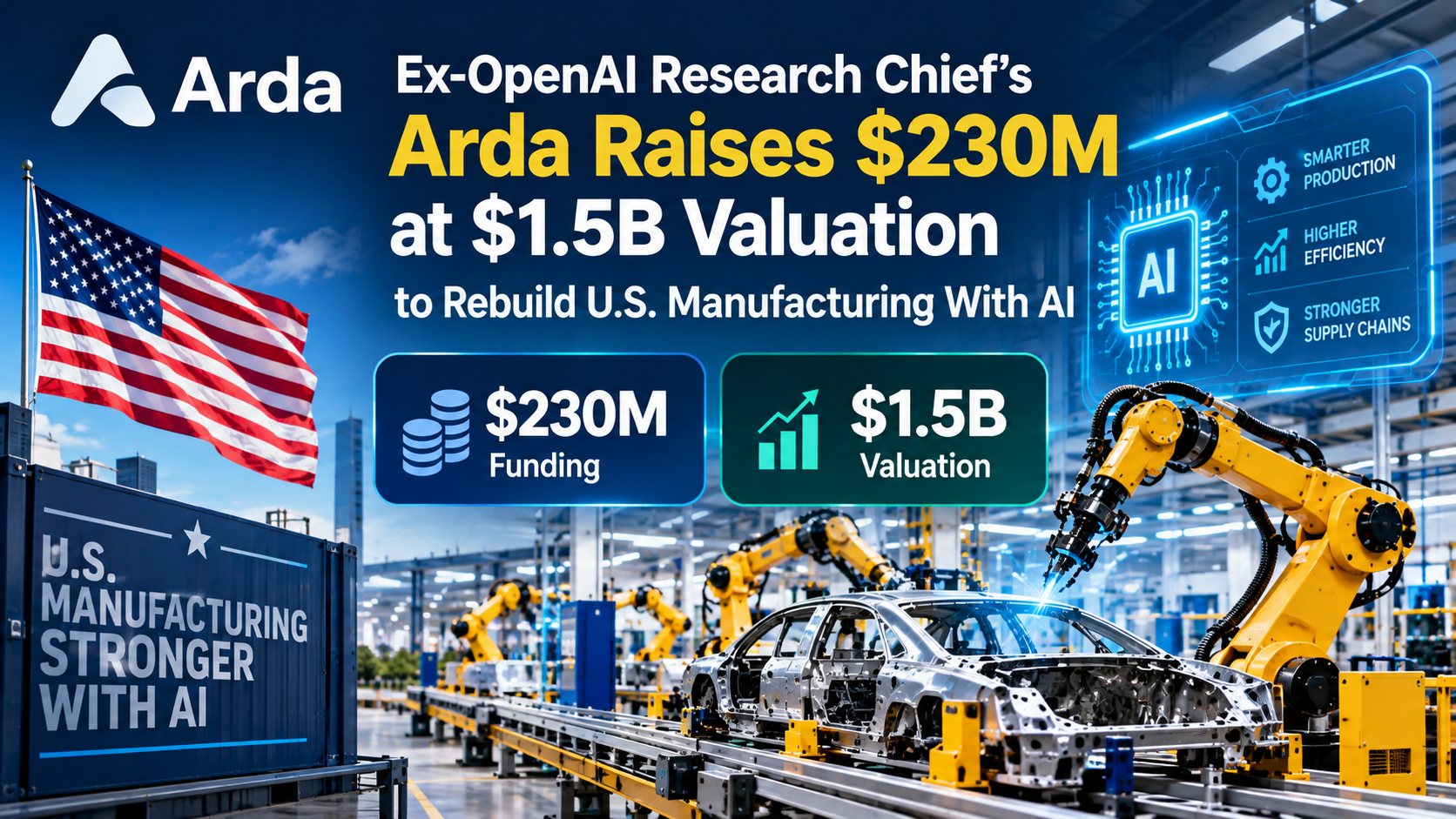
Ex-OpenAI Research Chief’s Arda Raises $230M at $1.5B Valuation to Rebuild U.S. Manufacturing With AI
Arda, founded by former OpenAI research chief Bob McGrew, has raised about $230 million at a $1.5 billion valuation. Its AI software helps U.S. factories retool production lines faster, and defense firm Anduril already uses it.

Date: Tuesday, October 20, 2026 · Time: 12:12 PM EDT
Arda, founded by former OpenAI research chief Bob McGrew, has raised about $230 million at a $1.5 billion valuation. Its AI software helps U.S. factories retool production lines faster, and defense firm Anduril already uses it.
Why This Funding Round Matters
Bob McGrew spent years at OpenAI and earlier at Palantir. On Tuesday, his startup Arda stepped out of stealth and told CNBC it had raised $230 million. Altimeter Capital, Accel and Khosla Ventures led the round. For American readers, the deal tests a big question: can AI do more than write text and code, and actually help bring factory work back home?
What Arda Actually Builds
An AI Assistant for Manufacturing Engineers
McGrew describes Arda’s product as an interface plus an AI agent that helps manufacturing engineers the way coding assistants help programmers. Engineers use it to design and adjust assembly lines faster. Behind the scenes, Arda mixes its own models, open-source models and a few frontier models.
Early Customer: Anduril
Arda’s models are already deployed at Anduril, a military technology company. Weapons and drones change design often, and retooling a line each time is slow and labor-heavy. Faster reconfiguration is exactly the problem Arda says it solves.
The Bigger Bet on U.S. Manufacturing
Apoorv Agrawal of Altimeter told CNBC that manufacturing is a $16 trillion global industry, and about $3 trillion of it is in the U.S. McGrew argues that products with frequently changing designs usually get built in East Asia because it is the only practical option. Arda wants flexible automation to change that. Robotics is next on its roadmap.
The timing also fits Washington’s push to bring manufacturing home. Still, Agrawal admitted the valuation is steep today. Reports in March said Arda was seeking $70 million at a $700 million valuation, so its value has more than doubled in about seven months.
What It Means for American Businesses
Practical Takeaways
- AI is moving beyond office software into physical operations. Many small firms already rely on AI tools in daily business operations; factories are the next frontier.
- Automation pays off most when it removes repeat work. Our guide on automating repetitive business tasks shows where to start.
- Test before you commit. The hidden costs of switching business software platforms can erase early savings.
Risks and Open Questions
Most details come from company statements to CNBC, so independent proof is limited. Arda names only one major customer so far, and its robotics plans are still ahead. Some outlets also report $232 million in total funding, including a $160 million Series A, so figures vary by report. Whether software alone can fix hardware bottlenecks remains unproven.
Conclusion
Arda’s launch shows investors are betting AI’s next big gains come on the factory floor. If it delivers faster retooling, American manufacturers could compete on products they now build overseas. If not, the valuation will look expensive. Watch for new customers and its first robotics release.
Author’s Review
I like that Arda targets a dull but costly problem: how slowly factories adapt when a design changes. That feels more practical than another chatbot. Still, I would treat the $1.5 billion price tag carefully. One named customer and a robotics plan on paper are not proof yet. I will be watching for real production numbers before calling this a turning point.
Elena Rostova
B2B Operations Consultant & Business Editor
Elena Rostova is a B2B strategy consultant specializing in digital operations, regulatory risk management, and scaling business models. She writes on corporate licensing, operational frameworks, and enterprise growth.