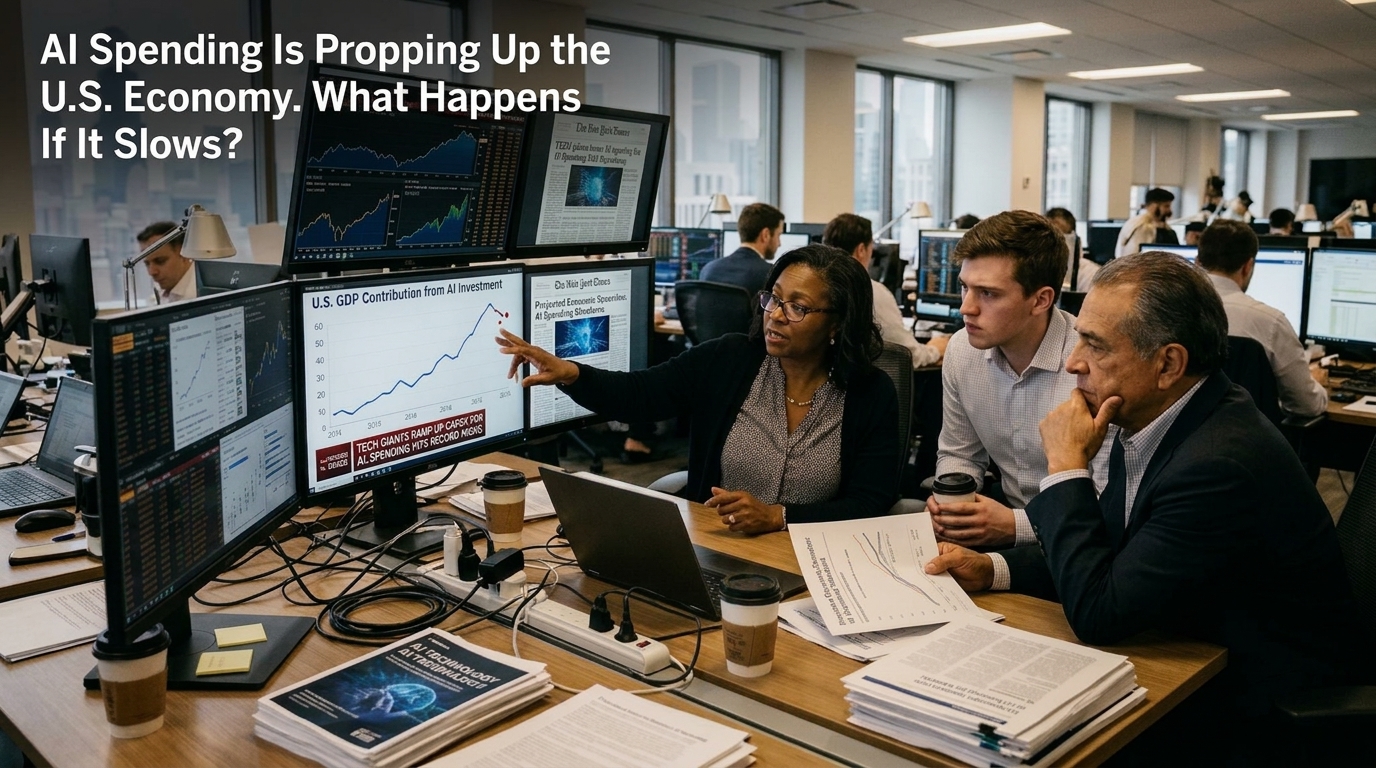
AI Spending Is Propping Up the U.S. Economy. What Happens If It Slows?
AI investment is helping hold up U.S. growth, but this week’s sharp tech selloff shows how fragile that support can be. Here is what the data says and what a slowdown could mean for Americans.

Author’s Review
Honestly, the Nasdaq’s rough Thursday isn’t what worries me. What worries me is how many good-news headlines rest on one bet. Data center spending lifts growth, stock gains lift household spending, and borrowed money helps pay for it. When one piece wobbles, the rest can follow. I’m not predicting a crash, just flagging a risk early.
What The Atlantic Is Warning About
Writer Matteo Wong argues in a new Atlantic article that AI investment is driving the American economy, calling it a dangerous tightrope. The worry isn’t that AI disappears. It’s that so much growth depends on spending that could slow if the payoff disappoints.
What Is an “AI Recession”?
It isn’t an official term. It describes a downturn set off by a sharp pullback in AI spending, or a break in the stock and credit boom around it. Economists define a recession as a significant, widespread decline in activity lasting more than a few months.
How Much Is AI Holding Up Growth?
The U.S. economy grew at a 3.4% annual rate in the third quarter, up from 2.2% in the second, according to the Bureau of Economic Analysis. That is an advance estimate, so it can change.
Government data has no AI category. ING estimated in August that tech and AI investment drives about a third of 2026 growth, while warning that may overstate AI’s role.
Microsoft, Alphabet, Amazon and Meta spent a combined $208.7 billion on capital expenditures in the third quarter, up 84% from a year earlier, according to The Motley Fool’s tally of earnings reports. Their 2026 plans total roughly $720 billion to $740 billion.
The Debt Factor
Borrowing is rising fast. Morgan Stanley data reported by the Financial Times show AI-linked companies raised about $466 billion in debt through September, versus $101 billion a year earlier. Slow AI revenue would hit lenders first. AI spending worries have already complicated Anthropic’s Nasdaq IPO plans.
This Week’s Warning Shot
On Thursday, the Nasdaq Composite fell 5.5%, its worst day since April 2025, and Nvidia dropped more than 9%, CNBC reported. Investors feared this week’s midterm results could slow the AI buildout. Doubts had been growing since Alphabet’s earnings miss in late October.
Still, the broader economy looks steadier than the stock market. Employers added 165,000 jobs in October, well above the roughly 59,000 economists expected, and unemployment slipped to 4.1%, the Bureau of Labor Statistics reported.
What a Slowdown Could Mean for You
Workers and Households
A sharp AI pullback would hit construction, chip and equipment suppliers first. Falling stock prices can also make households spend less.
Investors
Check how much of your 401(k) or index fund sits in a few AI-linked tech stocks. Avoid panic selling after one bad day, and consider asking a licensed advisor. This is not financial advice.
Small Businesses
Keep a cash cushion and avoid budgets that assume the AI boom continues unchanged.
What to Watch Next
Watch the BEA’s second GDP estimate on November 25, whether AI revenue justifies the spending, and credit markets. The Atlantic’s David Frum also asks whether an AI recession is coming in this 10-minute episode of The David Frum Show.
Frequently Asked Questions
Is the U.S. in a recession right now?
Current data doesn’t show one. GDP grew 3.4% in the third quarter, and October unemployment was 4.1%.
How much of U.S. growth comes from AI?
There is no official figure. ING estimates about a third, though that may be overstated.
Should I sell tech stocks after the Nasdaq drop?
There is no one-size answer, and one bad day isn’t a trend. Review your diversification and goals, and consider asking a licensed advisor.
AI is lifting the U.S. economy, but relying on one engine carries risk. The numbers show no recession today, only a growth story riding on spending that must eventually pay off. Watch the data, not just the headlines.
Elena Rostova
B2B Operations Consultant & Business Editor
Elena Rostova is a B2B strategy consultant specializing in digital operations, regulatory risk management, and scaling business models. She writes on corporate licensing, operational frameworks, and enterprise growth.