Smartwatch Tech Could Help Control Prosthetic Hands, Northwestern Researchers Say
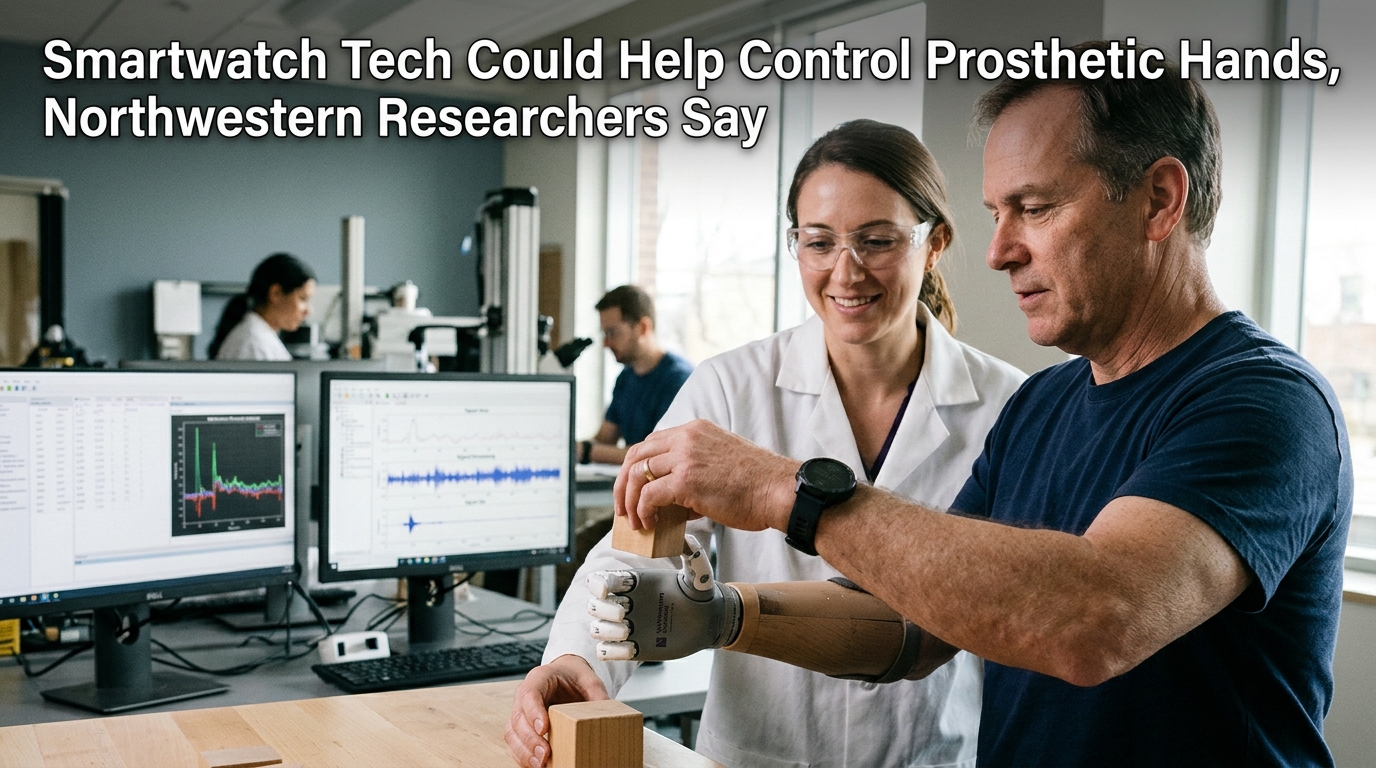
Northwestern University engineers have built two smartwatch systems that read hand and arm movements using only wrist sensors. Researchers say the work could someday help control prosthetic hands, but it is still early-stage research.

Author’s Review
This is the kind of story that keeps me following wearable tech. A watch that senses your fingers without a camera is clever, and the accessibility angle matters. Still, “could help control prosthetic hands” is doing a lot of work in that headline. The accuracy is promising within one session and much weaker across days and people. I see a smart first step, not a product yet.
What Northwestern’s Team Built
Engineers at Northwestern’s McCormick School of Engineering in Evanston, Illinois, presented two studies on Nov. 3 at the ACM Symposium on User Interface Software and Technology in Detroit. Computer scientist Karan Ahuja, who directs the SPICE Lab, led both.
EITWatch: Reading Muscles and Tendons
EITWatch places eight small electrodes on the back of a watch. They send tiny electrical signals through the wrist, a technique called electrical impedance tomography, to map the muscles and tendons beneath the skin. Each gesture creates a distinct pattern the system can learn. In Northwestern’s examples, a thumbs-up could send a text, while a pointed finger could start a step counter.
TransfHAR: Learning Your Own Movements
TransfHAR uses the accelerometer and gyroscope already inside smartwatches. It was pretrained on more than 2,700 hours of public motion data, then taught new activities from short demonstrations. In a 10-person study, it recognized seven new activities with about 90% accuracy after a single one-minute recording of each.
How Accurate Is It?
In a 12-participant study, EITWatch recognized six common hand gestures with over 92% accuracy and five subtler finger movements with over 91%. The catch is that it works best when calibrated to one wearer. According to the research paper’s abstract, accuracy fell to about 73% and 70% when the watch was put on again two days later, and to about 63% and 55% for new users with no training data. The team’s next steps are fitting the electronics inside a watch and removing the calibration step.
Why Prosthetic Hands?
Researchers say the same wrist signals that reflect intended hand movement might help steer prosthetic hands. Cameras can track hands too, but only when the hand is in view, and they raise privacy concerns. Ahuja called the work “a strong starting point.”
Many muscle-controlled prosthetics today rely on electromyography (EMG) sensors on the skin. In a 2025 YouTube review of Psyonic’s Ability Hand, tech reviewer Marques Brownlee tapes two EMG sensors to his forearm. The app compares the difference between the two signals to open or close the grip, and a harder flex moves it faster. A watch-based approach could, in theory, offer another route. But the accuracy figures above come from gesture-recognition tests, and Northwestern describes prosthetic control as something researchers are still exploring.
What It Means for U.S. Readers
Nothing here is for sale, and Northwestern’s announcement gave no release timeline. Still, the research points toward more accessible wearables: gesture input for people who struggle with touchscreens, and camera-free activity monitoring in settings like elder care. Google Health Research scientist Xin Liu co-authored TransfHAR, and Ahuja says the team is working with Google partners to scale up its data. EITWatch can also run its gesture model on a small onboard chip, part of the broader push toward on-device processing we covered in our explainer on the Surface Laptop Ultra with Nvidia RTX Spark. For a wider view, see our look at the innovations driving the future of technology.
Practical takeaway: if you or a family member uses a prosthetic, current options still come through a prosthetist. Treat this as a research signal, not a purchase decision.
Conclusion
Northwestern’s smartwatch research shows the wrist holds more information about the hand than today’s watches use. Whether that becomes better prosthetic control depends on solving accuracy across days and across wearers.
Frequently Asked Questions
Can a smartwatch control a prosthetic hand today?
No. EITWatch and TransfHAR are research projects, and Northwestern says prosthetic control is something researchers are exploring.
Can I buy this smartwatch?
No. EITWatch is a research prototype, and Northwestern’s announcement did not include a release date.
How is this different from camera-based hand tracking?
EITWatch senses muscles and tendons through electrical signals instead of video, so it can work when the hand is out of view and avoids putting a camera on the wrist.
Elena Rostova
B2B Operations Consultant & Business Editor
Elena Rostova is a B2B strategy consultant specializing in digital operations, regulatory risk management, and scaling business models. She writes on corporate licensing, operational frameworks, and enterprise growth.