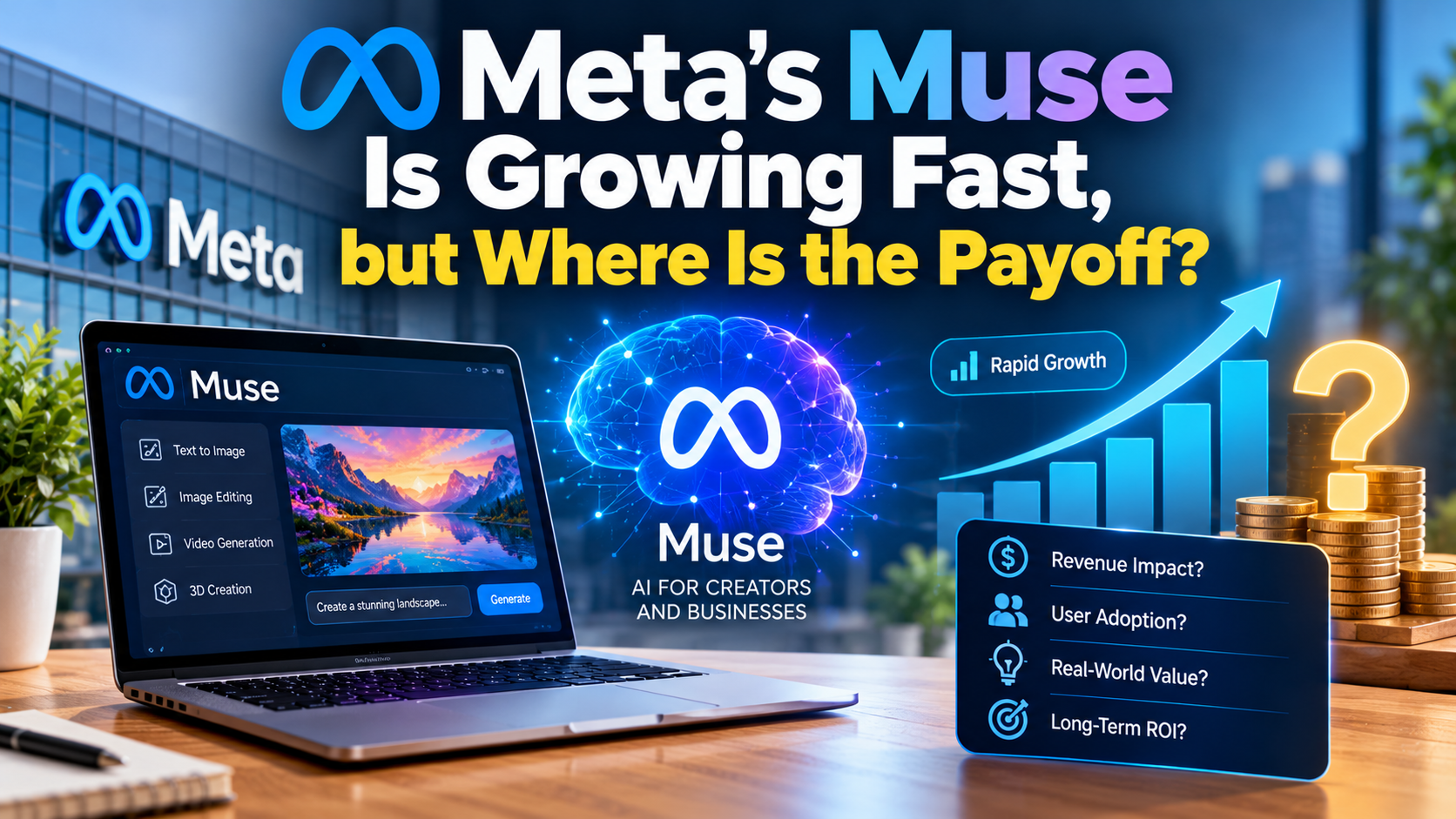
Meta's Muse Is Growing Fast, but Where Is the Payoff?
Meta's Muse AI agent has passed 10 million users in the U.S. and Canada since its September 8 launch, yet Meta plans to spend up to $145 billion on AI infrastructure this year, and Muse revenue remains unproven.

Date: Friday, October 23, 2026 · Time: 11:11 PM PKT (2:11 PM ET)
Meta's Muse AI agent has passed 10 million users in the U.S. and Canada since its September 8 launch, yet Meta plans to spend up to $145 billion on AI infrastructure this year, and Muse revenue remains unproven.
Few AI launches have grabbed attention this quickly. For Meta, though, popularity is only half the story. Investors now want to know whether an AI agent can pay for the data centers behind it.
What Muse Does
Muse is Meta's personal AI agent. It can search the web, compare products, book travel and make purchases with user approval. It reached No. 1 on Apple's U.S. App Store within 10 days of launch. On its third-quarter call, CEO Mark Zuckerberg said more than 10 million people had set it up. Meta has reportedly held back a wider rollout because the agent needs heavy computing power.
The Spending Problem
Ads Are Paying the Bills
Meta’s third-quarter revenue rose 26% to $64.6 billion on stronger advertising. But capital spending hit $34.9 billion in the quarter, and free cash flow turned negative at $2.1 billion, as Fortune reported. Meta now expects 2026 capital expenditures of $135 billion to $145 billion.
What Analysts Expect
Estimates vary widely. Citi says Muse could generate more than $27 billion a year by 2030, according to Yahoo Finance. Deutsche Bank’s range runs from $2.4 billion to $36 billion. Bank of America warns Muse will consume capacity without near-term revenue through at least next year.
How Meta Could Make Money
- Subscriptions: A free tier exists, with reported paid plans at $20 and $100 per month for heavy users.
- Commerce fees: Meta President Dina Powell McCormick has said Meta could take a fee when Muse completes a transaction or saves users money.
- Advertising: Some analysts see ads as the stronger model as agents help people discover and buy products.
What It Means for U.S. Users and Small Businesses
Agents like Muse could change how Americans shop and how small businesses get found. A few practical steps:
- Test new agents on low-risk tasks, and review every purchase before approving it.
- Watch recurring fees. Small plans add up, as covered in our look at subscription fatigue.
- Business owners can study the role of AI tools in daily operations and automating repetitive tasks before committing to one platform.
Conclusion
Muse proves people want AI agents. It does not yet prove they will pay enough to cover Meta's spending. Pricing details, shopping fees and a wider rollout will show whether the payoff is real. For now, strong ad growth is carrying the bill.
Author's Review
I find Muse's growth impressive, but I would not call it a payoff yet. Ten million sign-ups are a strong start, yet sign-ups do not pay for $140 billion in infrastructure. I like that Meta has several revenue paths. What worries me is how much rests on forecasts. Before calling this a win, I would watch free cash flow and Muse pricing over the next few quarters.
Elena Rostova
B2B Operations Consultant & Business Editor
Elena Rostova is a B2B strategy consultant specializing in digital operations, regulatory risk management, and scaling business models. She writes on corporate licensing, operational frameworks, and enterprise growth.