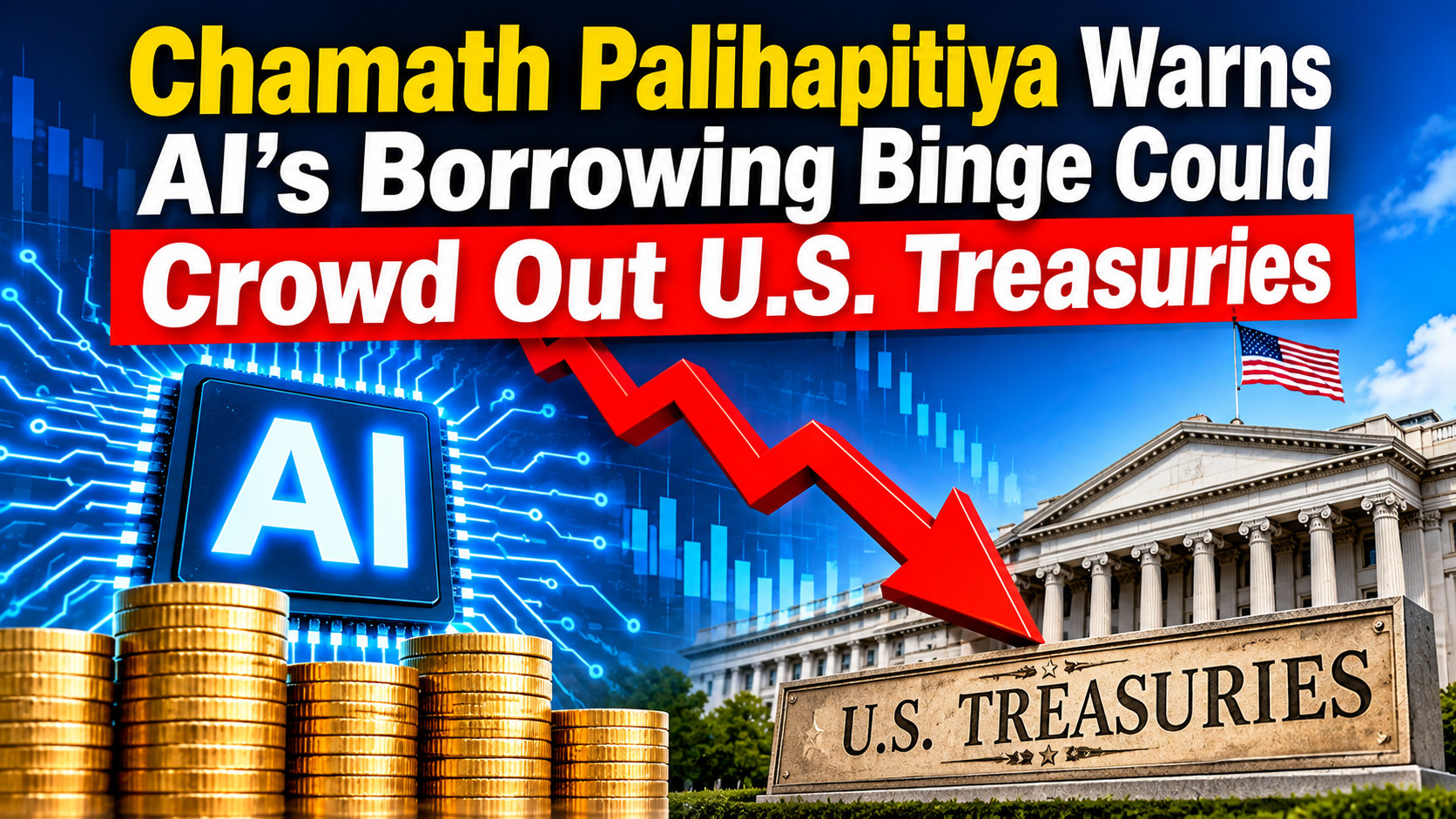
Chamath Palihapitiya Warns AI's Borrowing Binge Could Crowd Out U.S. Treasuries
Investor Chamath Palihapitiya says the AI industry already owes an estimated $340–$400 billion and may soon compete with the U.S. government for investor cash. Reuters data shows Big Tech’s AI spending now exceeds the cash it generates.
Date & Time: Tuesday, November 3, 2026 · 5:49 PM UTC
Investor Chamath Palihapitiya says the AI industry already owes an estimated $340–$400 billion and may soon compete with the U.S. government for investor cash. Reuters data shows Big Tech’s AI spending now exceeds the cash it generates.
What Palihapitiya Said
On the Oct. 30 All-In podcast, Palihapitiya said “the entire United States economy is levered to the AI complex,” pointing to seven or eight companies that set the tone for the country. These once cash-rich firms, he argued, are depleting their cash and now have to raise debt.
He estimated the AI complex owes $340–$400 billion to the market, as Benzinga reported. He also said what AI firms need to raise through the end of 2027 equals about 30% of what the Treasury plans to issue in that period. Both figures are his own estimates, not official government statistics.
The Numbers Behind the Warning
Spending Now Exceeds Cash
A Reuters analysis found Microsoft, Alphabet, Amazon, Meta and Oracle generated a record $542.9 billion in operating cash flow in the first nine months of 2026, up 29%. But their capital spending doubled to $556.9 billion, topping that cash for the first time in data going back to 2011. Combined free cash flow swung from a $143.5 billion surplus to a $14 billion deficit.
Buybacks Nearly Disappeared
Share buybacks fell 83% to $13.6 billion. Alphabet, whose latest earnings already rattled investors, and Meta have not repurchased any shares in 2026. Dividends rose to $37 billion from $33.9 billion, but the five companies returned just 9.3% of their cash to shareholders, down from 27.4% a year earlier.
Why it matters: Buybacks shrink the share count, lifting earnings per share even when total profit stays flat. Without them, per-share growth must come from real profit growth.
Meta Shows the Pressure
On Oct. 30, S&P Global Ratings revised Meta’s credit outlook to negative from stable, citing uncertainty over its capital spending and free operating cash flow. Meta keeps its AA- rating, and a negative outlook is a warning, not an immediate downgrade. S&P forecasts Meta’s free operating cash flow deficits at $39 billion in 2026 and $71 billion in 2027. Meta expects to spend $135–$145 billion on capital projects this year and told Reuters it disagrees with S&P’s view of its AI monetization.
Why Treasuries Enter the Picture
The same investors often buy both corporate bonds and U.S. Treasuries. If AI companies issue far more debt, Palihapitiya argues, they compete with the government for that money. Companies may have to offer higher returns, which raises the bar their AI projects must clear. If the Treasury must pay more at auction instead, he warned, borrowing costs could rise across the economy. Investor worries over AI spending have already been building across the sector.
The Other Side of the Argument
This is not a collapse forecast. Demand looks strong: Azure’s 48% growth suggests the buildout is serving real customers. On the same episode, co-host David Sacks argued these companies would not spend at this scale without believing in the returns. As TheStreet noted, the financial equation does not need to break for AI to get harder; it only has to become more expensive to fund.
What U.S. Readers Should Watch
- Free cash flow: does it turn positive again?
- Buybacks: a return would signal these firms earn more than they need.
- Borrowing costs: Treasury yields and corporate bond pricing.
Tech and communication services stocks make up about 43.5% of U.S. market value, per MSCI figures cited by Reuters, so index-fund investors are exposed. This article is not investment advice.
Conclusion
Palihapitiya’s warning shifts the AI debate from “Will AI work?” to “Who pays for it, and at what price?” The data confirms Big Tech is spending more than it earns, while his Treasury estimate remains unverified. The next earnings reports will show whether profits are catching up to the spending.
Frequently Asked Questions
What did Chamath Palihapitiya say about AI debt?
On the Oct. 30 All-In podcast, he estimated the AI complex owes $340–$400 billion and said its funding needs through 2027 equal about 30% of expected Treasury issuance. Both are his own estimates.
Why did Big Tech buybacks fall 83%?
Capital spending on AI doubled to $556.9 billion, exceeding operating cash flow of $542.9 billion, leaving little spare cash for repurchases, according to Reuters.
Does this mean an AI bubble is about to burst?
Not necessarily. These reports do not predict one. Demand remains strong, but AI profits must grow fast enough to justify rising costs.
Author’s Review
Here is my honest take. AI demand is not the problem; Microsoft’s Azure just grew 48%. The problem is the bill. Companies that once bought back stock are now borrowing to build data centers, and anyone with a retirement account is indirectly along for the ride. Palihapitiya’s Treasury figure is his own estimate, so treat it as a warning light, not a fact. The cash-flow numbers, however, are real.
Elena Rostova
B2B Operations Consultant & Business Editor
Elena Rostova is a B2B strategy consultant specializing in digital operations, regulatory risk management, and scaling business models. She writes on corporate licensing, operational frameworks, and enterprise growth.