Nvidia Shares Drop Following Jensen Huang Updates as U.S. Tech Sell-Off Deepens
Nvidia shares fell over two consecutive sessions on November 24 and November 25, 2026, erasing part of Monday’s 31.48% relief rally following Jensen Huang’s reinstatement as CEO. While Huang’s return initially lifted Wall Street, renewed scrutiny over ongoing federal probes, December Federal Reserve rate hike bets, hot inflation figures, and broader artificial intelligence valuation fears pulled NVDA to close at $149.30 (-3.91%) after dipping to an intraday low of $141.17.

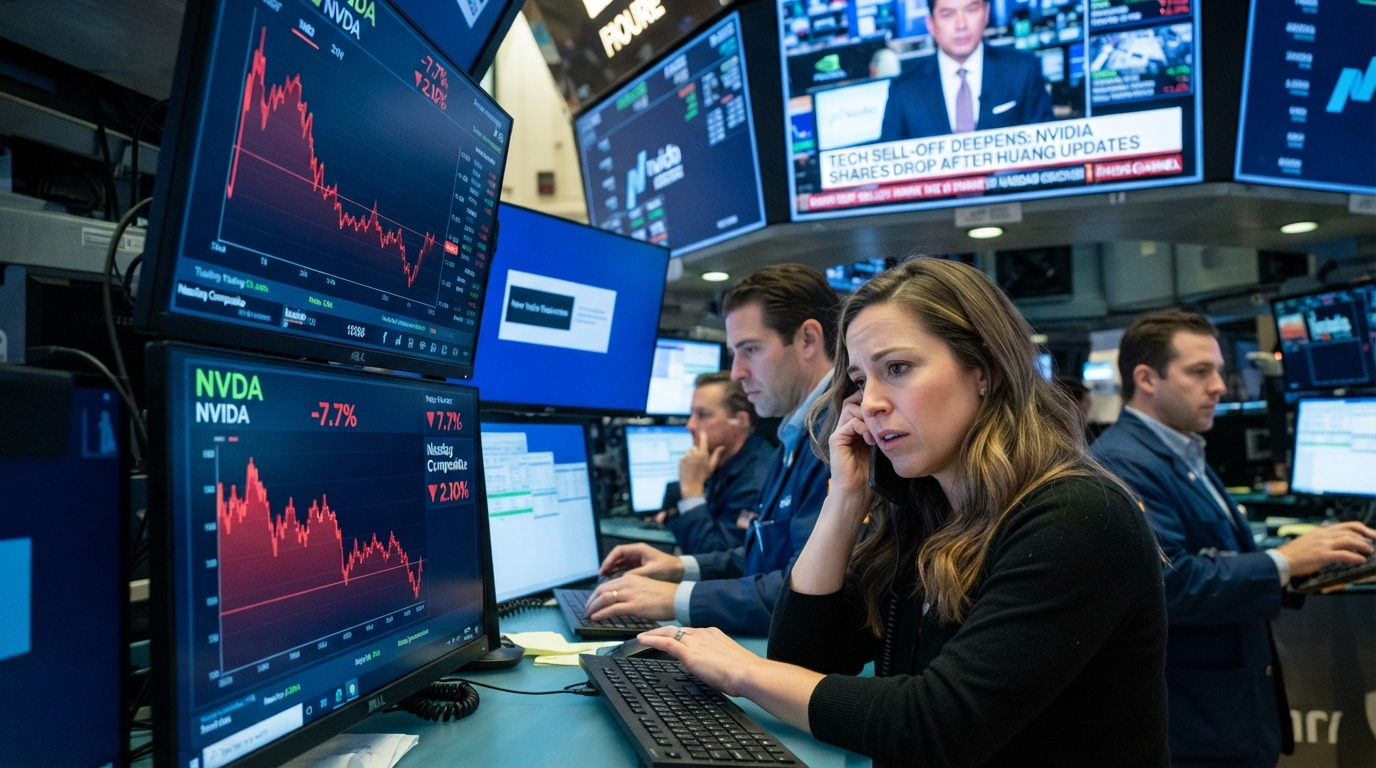
This image is AI-generated and is for informational purposes only. It is an illustration and does not depict a real event, person, or photograph.
Disclaimer: This article is for informational purposes only and does not constitute investment, financial, or trading advice. Stock prices change rapidly and the figures mentioned here reflect market conditions at the time of publication. Please verify prices from an official exchange or financial data provider and consult a licensed financial advisor before making any investment decision. We are not affiliated with Nvidia.
Author’s Review
For everyday U.S. retail investors watching their 401(k)s and tech portfolios swing wildly this week, Nvidia’s rollercoaster proves that one leadership headline cannot fix deeper market anxieties. Bringing Jensen Huang back steadied operational confidence, yet Wall Street is clearly shifting from blind AI optimism toward hard questions about corporate governance, interest rates, and whether massive data-center spending can sustain its pace.
Why Nvidia Stock Reversed After Jensen Huang’s Comeback
After soaring 31.48% to close at $165.05 on Monday, November 23, following the official Nvidia board announcement reinstating Jensen Huang as president, CEO, and director, NVDA reversed course. Shares fell 5.86% to $155.38 on Tuesday and dropped another 3.91% (a $6.08 decline) to close at $149.30 on Wednesday, November 25, after recovering from an intraday low of $141.17.
The whipsaw came less than two weeks after Nvidia’s board reinstated Huang just 12 days after his November 12 resignation, during which CFO Colette Kress served as interim chief executive. During an all-hands update to employees, Huang apologized for personal mistakes, stated he is attending therapy, and vowed to become a better leader, as covered in ANC’s Market Edge broadcast on YouTube.
For leadership reinstatement background, see Nvidia’s board reinstated Huang. For earlier context, see the 14% slide triggered by Huang’s exit fallout.
Key Pressures Weighing on U.S. Tech Investors
1. Ongoing Congressional and Governance Probes
Although Nvidia’s board cited senior U.S. government input confirming no national security breach, an independent board committee probe remains active. Three U.S. House committee chairs confirmed executive interviews will proceed, and Huang is scheduled to testify before the Senate Banking Committee on December 3 regarding U.S. chip export controls. Institutional holders, including New York City Comptroller Mark Levine, also criticized the board’s abrupt reversal after the earlier 14% slide triggered by Huang’s exit fallout.
2. Broader AI Sell-Off and December Rate Hike Bets
Nvidia’s decline unfolded alongside a wider retreat across U.S. equities. Hot October PCE inflation data (3.8% YoY) and proposed international tariffs led bond traders to price in high odds of a quarter-point Federal Reserve rate hike in December, raising borrowing costs for debt-funded AI data centers. Rival chipmakers and AI names also slipped, with Anthropic dipping below its $83 IPO price before closing at $82.79 and AMD declining 1.75%.
Strong Fundamentals vs. Near-Term Market Volatility
Despite governance headlines, operational demand remains intact. In its Q3 fiscal 2027 financial results, Nvidia reported record revenue of $115.8 billion—up 103% year over year—and Data Center sales of $107.6 billion, alongside shipments of its Vera Rubin NVL72 platform. Fourth-quarter revenue guidance stands at $130.0 billion, excluding China Data Center compute sales.
Practical Takeaway for U.S. Investors: Long-term shareholders should separate core earnings power from political headlines. With Senate testimony ahead on December 3 and Fed policy tightening in view, staggered dollar-cost averaging helps manage sharp single-day swings better than chasing relief rallies.
Nvidia (NVDA) Market & Financial Snapshot (November 2026)
| Metric / Event | Figure / Detail | Market Impact |
|---|---|---|
| NVDA Close (Nov 23, 2026) | $165.05 (+31.48%) | Relief rally on CEO reinstatement |
| NVDA Close (Nov 24, 2026) | $155.38 (-5.86%) | Profit-taking & tech sector pullback |
| NVDA Close (Nov 25, 2026) | $149.30 (-3.91%) | Pared intraday losses from $141.17 low |
| Q3 FY2027 Revenue | $115.8 Billion (+103% YoY) | Data Center sales hit $107.6 billion |
| Q4 FY2027 Revenue Guidance | $130.0 Billion (+/- 3%) | Excludes China Data Center compute |
Conclusion
Jensen Huang’s return restored technical leadership at Nvidia, but it did not erase regulatory oversight or macroeconomic headwinds. Until Capitol Hill hearings conclude and interest rate expectations stabilize, U.S. tech investors should expect elevated volatility across semiconductor and AI stocks.
Frequently Asked Questions (FAQs)
Why did Nvidia stock fall after Jensen Huang returned as CEO?
Investors locked in profits after Monday’s 31.48% surge as ongoing congressional investigations, board governance criticism, and fears of a December Federal Reserve rate hike outweighed relief over Huang’s return.
Is Nvidia’s core AI chip business slowing down?
No. Nvidia posted $115.8 billion in Q3 fiscal 2027 revenue (up 103% year over year) and projected $130.0 billion for Q4, supported by strong Vera Rubin NVL72 shipments.
What is the next major catalyst for Nvidia shareholders?
Jensen Huang’s scheduled public testimony before the U.S. Senate Banking Committee on December 3, 2026, regarding chip export controls, alongside the Federal Reserve’s December rate decision.
Elena Rostova
B2B Operations Consultant & Business Editor
Elena Rostova is a B2B strategy consultant specializing in digital operations, regulatory risk management, and scaling business models. She writes on corporate licensing, operational frameworks, and enterprise growth.
Follow Tech Level Business on Google
Add us as a preferred source to find more of our journalism in Google Search.